Neighbouring markets. New possibilities for your project.
Uzbekistan is a substantial manufacturing and consumer market in Central Asia. Kyrgyzstan can complement that base with a local company, regional sales, a technology team or an investment structure.
VM.Capital helps Uzbek companies and private clients assess an appropriate model, prepare documentation and establish operations in Kyrgyzstan. We explain which opportunities fit your objectives, the ongoing support required and the conditions that must be met.
Uzbekistan today: growth, production and regional connections
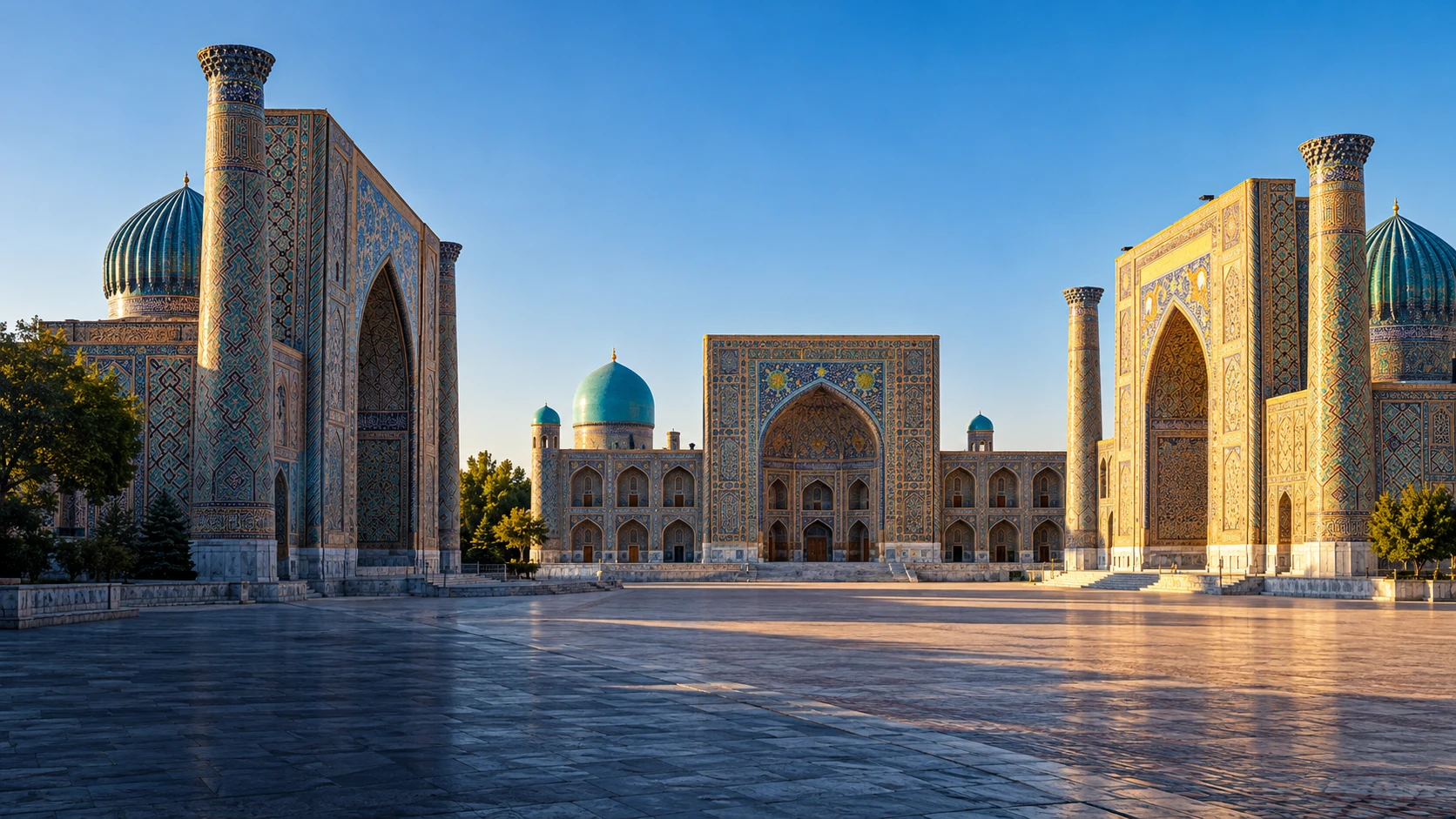
Tashkent concentrates administration, finance and business services. The Fergana Valley is important for manufacturing and trade; Samarkand and Bukhara for tourism and services. Textiles, automotive production, food processing, gold and copper mining, construction and digital services are significant activities.
As a landlocked country, Uzbekistan depends on routes through neighbouring states and reliable supply arrangements. Market growth creates opportunities while increasing the importance of financing, energy supply, skills and sales organisation.
Real GDP: +8.5%
Preliminary growth in January–June 2026 compared with the same period of 2025, according to the National Statistics Committee.
Manufacturing capabilities
Textiles, automotive assembly, processing and industrial cooperation provide a basis for joint ventures and regional supply chains.
Neighbouring markets
Uzbekistan borders Kyrgyzstan, Kazakhstan, Tajikistan, Turkmenistan and Afghanistan. Each destination has its own market-access requirements.
The Kyrgyz border: from settlement to cooperation
Legal certainty at the border provides a foundation for cross-border trade, transport and joint production. In November 2022, the two countries signed a treaty on certain sections of the state border and an agreement on joint management of the Andijan (Kempir-Abad) reservoir’s water resources. The instruments were ratified.
In January 2023, the presidents announced the full settlement of delimitation issues. In March 2025, Kyrgyzstan, Uzbekistan and Tajikistan signed a treaty on the junction of their three borders. These developments do not remove customs clearance, border controls or shipment-specific requirements.
International frameworks: connections and practical limits
SCO and Organisation of Turkic States
Both countries participate in these organisations. The frameworks support intergovernmental cooperation, business dialogue and transport connections.
EAEU: different statuses
Kyrgyzstan is an EAEU member; Uzbekistan has observer status. Observer status does not confer membership or automatically provide common trade or employment rights.
Market access depends on the product
Incorporating in Kyrgyzstan does not itself change the origin of Uzbek goods. We assess customs procedures, origin documentation, taxes, certification and applicable restrictions.
Joint projects: what operates and what is being developed
Tulpar Motors automotive production
The joint manufacturing venture in Chui Region was officially opened in July 2024. It illustrates industrial cooperation between the two countries beyond trading finished products.
China–Kyrgyzstan–Uzbekistan railway
The railway is under construction. It is relevant to future transport opportunities; current shipments should be planned using available routes without assuming a commissioning date.
Kambarata-1 hydropower project
Kyrgyzstan, Kazakhstan and Uzbekistan are developing the joint project. September 2026 negotiations addressed the intergovernmental agreement, governance and financing. The power plant is not operational.
How a Kyrgyz structure can complement an Uzbek business
Regional sales
Local contracting, customer relationships and distribution channels. Assess partners, product requirements, payment arrangements and supply economics.
ExploreManufacturing and joint ventures
Assembly, processing or a dedicated production function. Compare sites, energy supply, staffing, permissions and sales conditions.
ExploreTechnology and business services
Software development, product support and selected internal functions. Establish governance, ownership of deliverables and potential HTP eligibility.
ExploreStart with a suitable model
Tell us about your business activity or target market. We will help establish where a Kyrgyz structure could add value.
Tax environment: compare the applicable regimes
Uzbekistan has its own incentive regimes, including IT Park. Relocation decisions should therefore reflect total costs and commercial objectives: taxes, payroll, mandatory contributions, management, banking and customer access.
Kyrgyzstan’s general regime
Standard rates include 10% corporate income tax and 12% VAT. These are distinct taxes with different application rules; the actual burden depends on activities and the applicable regime.
High Technology Park
Eligible residents benefit from exemptions from corporate income tax, VAT and sales tax, alongside a 1% revenue contribution to the HTP Directorate. Employee-related obligations require separate assessment.
Tamchy SFIT
Special tax treatment applies to activities covered by the SFIT regime within its territory. It does not exempt every owner’s income or transactions outside that scope.
Tamchy SFIT: assess suitability before incorporation
Uzbek companies and individuals can explore investment structures, asset holding, family offices and other permitted activities. The proposed activity, presence, governance, authorisations and banking arrangements must be assessed.
VM.Capital cooperates with Tamchy SFIT. We help compare this option with an ordinary Kyrgyz company and other suitable regimes. Entity registration and authorisation for regulated activities are separate matters.
For private clients: clear options for a specific need
Banking arrangements
Prepare account-opening documents, source-of-funds explanations and responses to bank enquiries. The bank decides whether to open an account and which services are available.
ExploreInvestments and family arrangements
Review proposed acquisitions, ownership arrangements, contracts and agreed governance rules. Assess legal and tax implications before committing.
ExploreResidence and documentation
Assess residence grounds and documentation according to nationality and individual circumstances. Company incorporation does not itself grant residence or citizenship.
ExploreFrom an initial idea to an operating model
01 · Define the objective
Establish the product, target countries, participants, expected payments and Kyrgyz company functions. Agree the scope and information required.
02 · Compare the options
Prepare recommendations on structure, tax treatment, permissions and implementation. Involve Uzbek-law specialists where needed.
03 · Implement the structure
Support incorporation, contracts and agreed procedures, followed by accounting, reporting and ongoing legal matters.
Explore the opportunities further
Gain clarity before your next step
Start with a consultation to establish the objective, information needed and a practical way forward.